

20 Self-Study Sequences for When You Don’t Know What to Study
Keeping your language practice flexible and effective

Some days you sit down to study your target language and you know exactly how to approach your learning. Other days you don’t. Or, you’re sick of doing what you always do. You know you should engage with the language as often as possible, but you’re not sure what that should actually look like.
I keep a running list of study sequences for exactly this moment: short, repeatable routines to reach for depending on the day, the energy you’ve got, and what you want to work on that day.
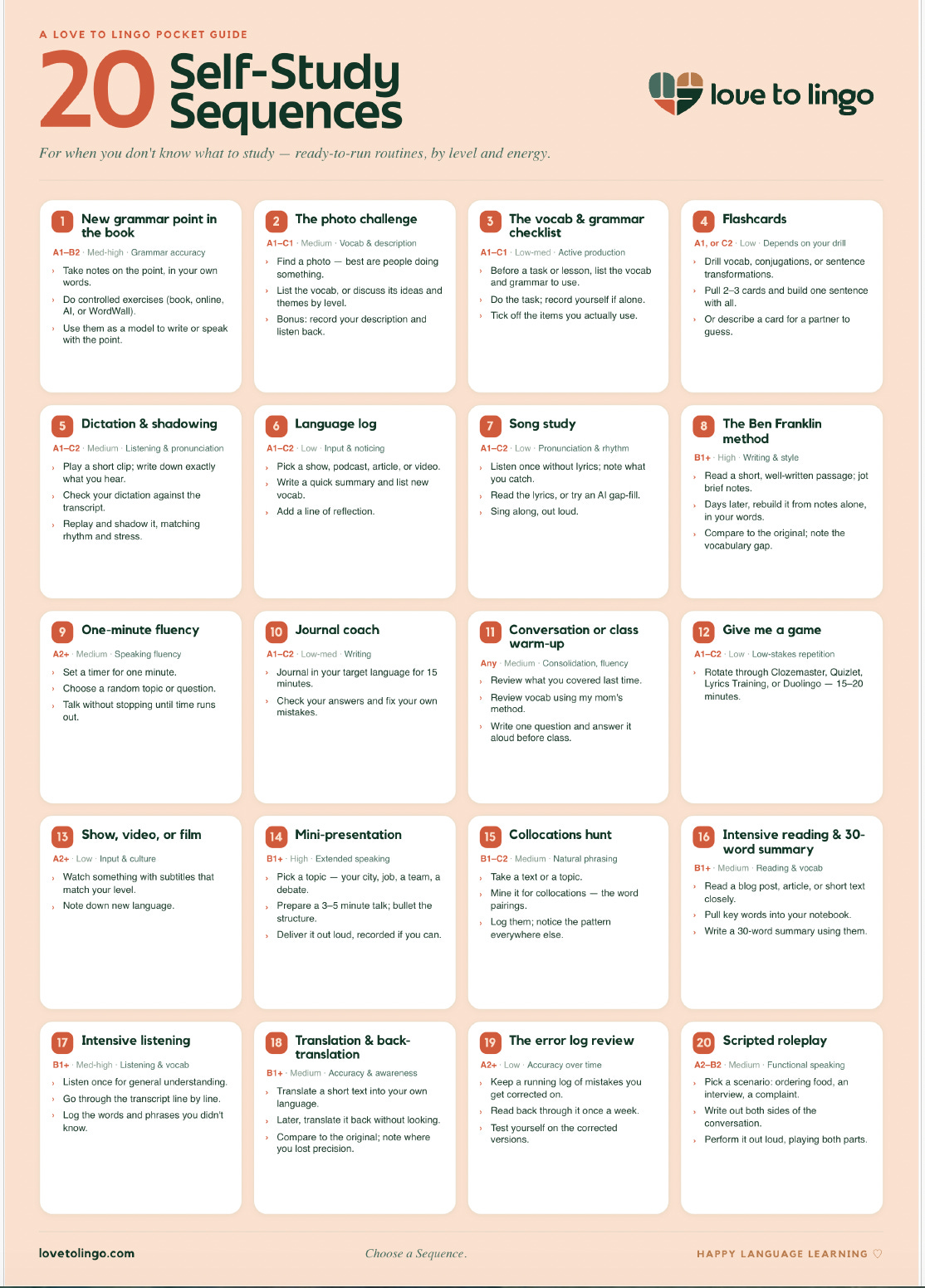
Here are the twenty sequences, with the level each one suits, how much energy it takes, and the language focus. I’ve put a ⭐️ next to my favorites. (Download the PDF below.)
1. New grammar point in the book ⭐️
Level: A1–B2 · Effort: medium-high · Focus: grammar
Take notes on the new point, in your own words.
Do controlled exercises (in your book, online, AI-generated or WordWall.)
Use the exercises as a model to either write or speak using the grammar point. (The post below gives you some ideas.)

2. The photo challenge
Level: A1–C1 · Effort: medium · Focus: vocabulary, grammar and speaking
Find a photo. The best are photos of people doing something.
Depending on your level, either list vocabulary in the photo or talk about the ideas/themes it shows.
As a beginner, take written notes first. As an advanced learner, take notes of more advanced language to try to include in your speaking.
Bonus points for recording your description and listening back.
3. The vocab and grammar checklist
Level: A1–C1 · Effort: low-medium · Focus: active production
Before a conversation, writing task, or lesson, list the vocabulary and grammar points you want to use.
Do the task. If alone, record yourself.
Tick off the items you use.
4. Flashcards
Level: A1, or C2 · Effort: low · Focus: depends on what you’re drilling
Use flashcards for vocab, verb conjugations or sentence transformations
Instead of just “memorizing” the vocab sets, pull two or three vocabulary cards out of the set and try to make a sentence using them together. Or if you have a partner, describe the words to your partner. Or play Pictionary and your partner has to guess the word.
5. Dictation and shadowing
Level: A1–C2 · Effort: medium · Focus: listening and pronunciation
Play a short clip and write down exactly what you hear.
Check your dictation against the transcript.
Play the clip again and shadow it: speak along in real time, matching rhythm and stress.
6. Language Log ⭐️
Level: A1–C2 · Effort: low · Focus: grammar, vocabulary, reading/listening, writing
Pick a show, a podcast, article, video whatever you’ve got energy for.
After you watch/read/listen, write a quick summary, a list of some new vocabulary and your reflection
7. Song study
Level: A1–C2 · Effort: low · Focus: vocabulary, grammar, listening, pronunciation
Pick a song.
Listen once without the lyrics and note what you catch.
Read the lyrics. You could also ask AI to make a gap-fill activity for you.
Sing along, out loud.
8. The Ben Franklin method
Level: B1+ · Effort: high · Focus: grammar/vocabulary, writing
Take a short, well-written passage.
Read it closely and jot down brief notes on the content.
Put the original away.
Days later, rebuild the passage from your notes alone, in your own words.
Compare your version to the original. Note the gap between the vocabulary you reached for and the vocabulary it used.
9. One-minute fluency ⭐️
Level: A2+ · Effort: medium · Focus: speaking fluency
Set a timer for one minute.
Choose a random topic to speak about. Or answer a random question.
Talk without stopping until the timer runs out.
10. Journal coach ⭐️
Level: A1–C2 · Effort: low-medium · Focus: grammar, vocabulary, writing
Journal in your target language for 15 minutes.
Check your answers and fix your own mistakes.
Read more below.

11. Conversation or class warm-up ⭐️
Level: any · Effort: medium · Focus: consolidation, fluency
Before a class or exchange, review what you covered last time.
Review vocabulary using my mom’s method.
Write at least one conversation question about the topic and answer it outloud to yourself before class.
12. Give me a game
Level: A1–C2 · Effort: low · Focus: low-stakes repetition
Rotate through Clozemaster, Quizlet, or Lyrics Training or DuoLingo for fifteen to twenty minutes.
13. Show, video, or film
Level: A2+ · Effort: low · Focus: grammar, vocabulary, listening, culture
Watch something with subtitles that match your level.
Note down new language.
14. Mini-presentation
Level: B1+ · Effort: high · Focus: extended speaking
Pick a topic. Your city, your job, favorite football team, why everyone should practice your sport, advantages and disadvantages of something, etc.
Prepare a short talk, three to five minutes. Write some bullet points to structure your presentation.
Deliver it out loud, recorded if you can manage it.
15. Collocations hunt
Level: B1–C2 · Effort: medium · Focus: vocabulary
Take a text or a topic.
Mine it for collocations, the word pairings that go together.
Log what you find.
16. Thirty word summary
Level: B1+ · Effort: medium · Focus: reading and vocabulary
Pick a blog post, newspaper article, or short text.
Read it closely.
Pull out the key words and add them to your notebook.
Write a 30-word summary of the text, using the key words.
17. Intensive listening
Level: B1+ · Effort: medium-high · Focus: listening and vocabulary
Pick a podcast episode or video.
Listen once for general understanding.
Go through the transcript line by line and mine it for vocabulary. (You can also just do sections if you are short on time/energy)
Log the words and phrases you didn’t know.
18. Translation and back-translation
Level: B1+ · Effort: medium · Focus: grammar-meaning mapping
Take a short text in your target language.
Translate it into your own language.
Put it away. Later, translate your version back into the target language without looking at the original.
Compare your version to the original. Note where you lost precision.
19. The error log review
Level: A1+ · Effort: low · Focus: accuracy over time
Keep a running log of mistakes you get corrected on.
Once a week, read back through it.
Test yourself: can you say the corrected version without checking?
20. Scripted roleplay
Level: A2–B2 · Effort: medium · Focus: functional speaking
Pick a real-life scenario: ordering food, a job interview, calling to complain.
Write out both sides of the conversation.
Perform it out loud, playing both parts.
You can try this using AI. The article below describes how.

Downloadable Guide
This PDF has all these sequences on one page. Save or print and tuck it into your notebook so you never run out of things to do.

The Language Practice
If you want to go beyond these sequences and build a more comprehensive routine, The Language Practice is the next step.
It’s a four-week workbook for intermediate learners: a short reading and a practical task each day, grounded in the theory of second language acquisition, so you understand the types of activities that tend to work best.
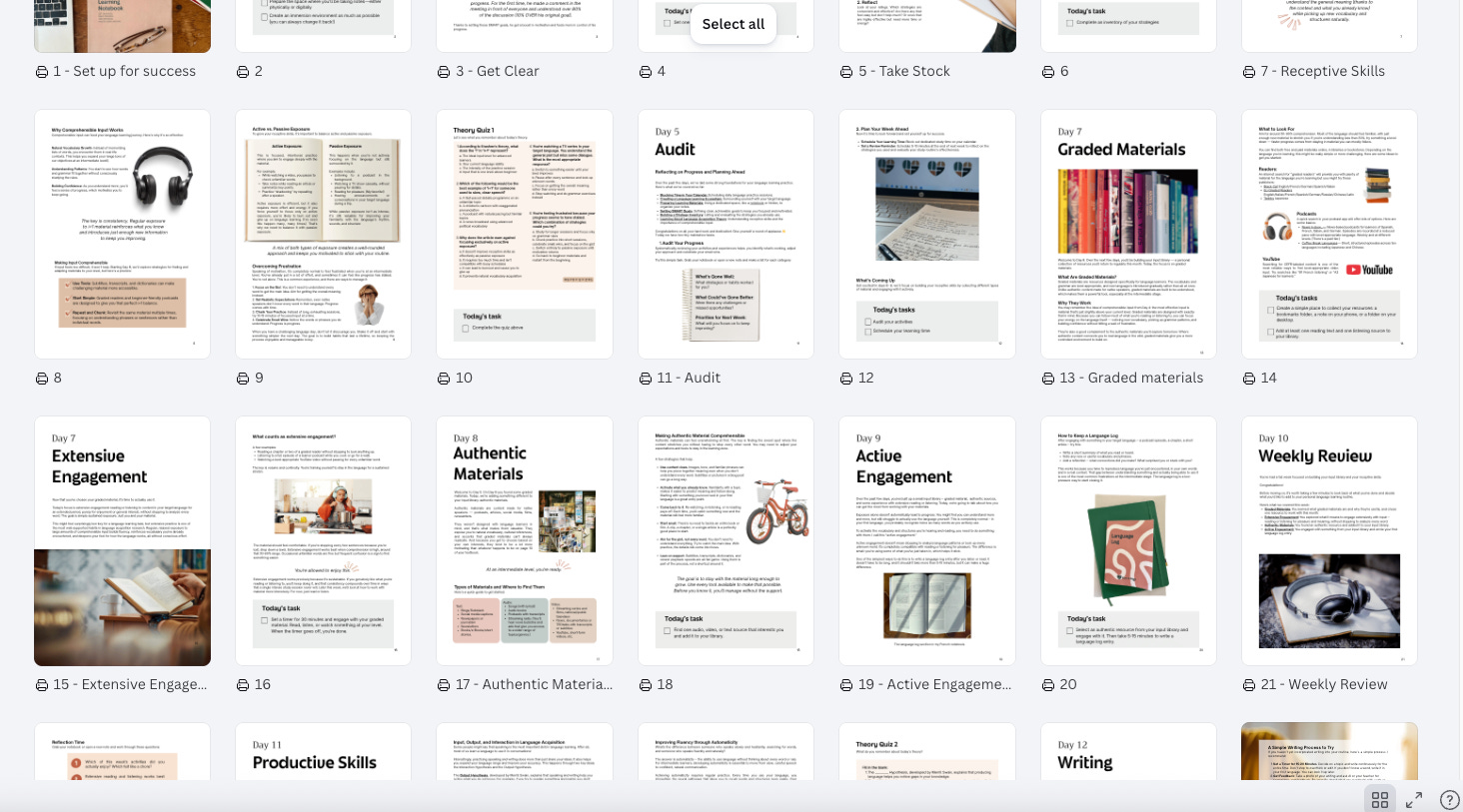
Each week builds on the last, and every fifth day is a reflection day, a chance to notice what’s working and adjust before you keep going. By the end you’ll have a routine that’s genuinely yours, not mine, not an app’s.
Paid subscribers already have access here. Everyone else can get it below.
Happy Language Learning! ♡
Connection through language has always been at the heart of Love to Lingo. Now, I'm finally building a space that reflects that. Think of it like the foreign language department of a university, without the exams.
It a place where you can:
Practice your target language, in a real context, with real people
Feel supported in your learning
Learn from experts who are passionate about their subject
And beyond the language, have something to look forward to. A reason to engage, to think, to connect with people who are curious about the world.
Here’s what’s coming in July:
10 July: Guest Lecture in Italian Comunicazione Interculturale with Emanuela B
17 July: Guest Lecture in Spanish Arte Rupestre en Andalucía with María C.J
31 July: Lit Club Session in Spanish 2 La Casa de los Espíritus
June-August Pilot Edition of Self-Study School in French (paid subscribers can sign up here)
Your resources are amazing! I'm already planning on using a random number generator to choose which sequence to do first.
The best part is that the sequences answer the real problem learners face after motivation: deciding what to do when the study window finally appears. Sorting routines by level, energy, and focus makes the list feel usable instead of inspirational. I especially liked the photo-description and pre-task vocabulary ideas because they turn vague practice into a small repeatable system.